 0
0
 language
  English
 русский
 Français
 Español
 Português
 عربى
عربى
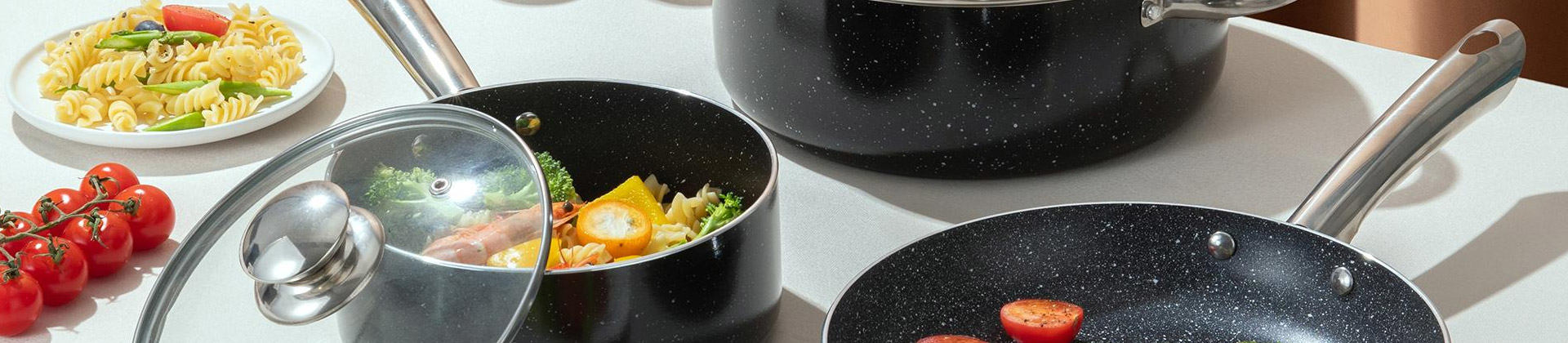
China Aluminum Cookware Factory Non-Stick Coating Technologies and Performance Analysis
Jun 12, 2026
Coating technology is a key part of modern cookware manufacturing, influencing surface behavior and cooking performance. Within a China Aluminum Cookware Factory, coating systems are developed through controlled material selection and application processes.
At the same time, Non-Stick Cookware Wholesale demand affects how coating performance is assessed. Wholesale buyers usually focus on durability, safety, stability, and consistency across production batches, which guides technology choices in manufacturing.
Main Types of Non-Stick Coatings
Non-stick coatings for aluminum cookware mainly include PTFE-based systems and ceramic-based systems.
PTFE coatings are applied in multiple layers to create a smooth surface that reduces food adhesion. Ceramic coatings are formed through sol-gel processes and provide a harder surface with stable heat behavior under moderate cooking conditions.
In a China Aluminum Cookware Factory, coating selection depends on product use requirements. In Non-Stick Cookware Wholesale markets, coating type is often judged by usability and long-term surface behavior.
Layer Structure Design in Coating Systems
Non-stick coatings are generally built in layers.
The base layer improves adhesion to aluminum. The middle layer supports thickness and structural stability. The top layer forms the cooking surface that directly contacts food.
This layered design helps balance surface smoothness and durability. A China Aluminum Cookware Factory applies strict layer control during production. For Non-Stick Cookware Wholesale supply, layered systems help maintain stable performance across different usage conditions.
Performance Evaluation of Coatings
Coating performance is commonly evaluated through abrasion resistance, heat stability, and food release behavior.
Abrasion resistance reflects surface durability under utensil contact. Heat stability measures coating behavior during repeated heating cycles. Food release performance shows how easily food separates from the surface.
A China Aluminum Cookware Factory uses these indicators during product development. In the Non-Stick Cookware Wholesale evaluation, these factors help determine suitability for different cooking environments.
Durability and Thermal Stability
Durability depends on coating formulation and application control. If coating thickness or curing conditions vary, surface stability may change over time.
Because aluminum conducts heat quickly, coatings must maintain stability under repeated temperature changes. This makes material compatibility important in cookware design.
For a China Aluminum Cookware Factory, durability testing is part of production control. For Non-Stick Cookware Wholesale buyers, stable performance across long-term use is an important consideration.
Testing Methods for Coating Performance
Common testing methods include scratch testing, heat cycling, and wear simulation.
Scratch tests evaluate surface resistance to mechanical impact. Heat cycling simulates repeated cooking temperature changes. Wear simulation helps observe long-term surface condition.
These methods are widely used in a Chinese Aluminum Cookware Factory. In Non-Stick Cookware Wholesale procurement, testing results help support product selection decisions.
Manufacturing Process Control
Coating performance is influenced by process control, including temperature, coating thickness, and curing time.
Stable production processes help reduce variation between products. This is important for maintaining consistent surface performance.
A China Aluminum Cookware Factory follows standardized procedures to manage production consistency. For Non-Stick Cookware Wholesale supply chains, this supports stable product quality across batches.
Application Environments
Non-stick cookware is used in household and commercial kitchens.
Household use focuses on convenience and cleaning ease. Commercial use requires more stable performance under frequent cooking cycles.
A China Aluminum Cookware Factory may adjust coating systems based on application needs. In Non-Stick Cookware Wholesale markets, product selection often depends on usage scenarios.
Non-stick coating technologies combine material selection, layer design, and process control. Performance evaluation focuses on durability, heat stability, and surface behavior during repeated use.
Share:
Related Products

Need Custom Cookware? OEM & ODM Experts – Contact Us Today!
-

0086-578-3183238
-

0086-13750930689
-

-

86-13750930689
https://www.pinterest.com/zhuohao2021/ -

No.3 Xinye Road, Jinyun Industrial Area, Zhejiang, China.
Copyright © Zhejiang Wantong Industry & Trade Co., Ltd.

OEM/ODM Kitchen Cookware Manufacturer