 0
0
 language
  English
 русский
 Français
 Español
 Português
 عربى
عربى
Can Cookware Design Improve Heat Distribution
May 01, 2026
Cooking is a science as much as an art. The way heat transfers from the stove to your ingredients affects flavor, texture, and even cooking time. Many chefs have discovered that the design of Cooking Pots And Pans can dramatically influence heat distribution, causing to more consistent, reliable results. Working with a trusted Professional Kitchen Cookware Supplier like Zhejiang Wantong Industry & Trade Co., Ltd., kitchen professionals gain access to cookware engineered for ideal performance, integrating material science and thoughtful design into every product.
1. Core Principles of Heat Distribution
Heat distribution in cookware depends on three factors: material, thickness, and design geometry. Even if a pan is made from high-conductivity metals like aluminum or copper, improper design can result in hotspots, uneven cooking, and inconsistent results.
Key Factors
Base Thickness: A thicker base spreads heat more evenly.
Layered Construction: Multi-ply pans combine metals (stainless steel, aluminum, copper) to balance durability and thermal conductivity.
Shape and Contour: Flat, wide bases maximize surface contact with the heat source, while curved edges can influence convection patterns for stews and sauces.
At Zhejiang Wantong Industry & Trade Co., Ltd., each Cooking Pot And Pan is crafted to balance these factors, ensuring even heat for both professional and home kitchens.
2. Flat vs. Rounded Bases
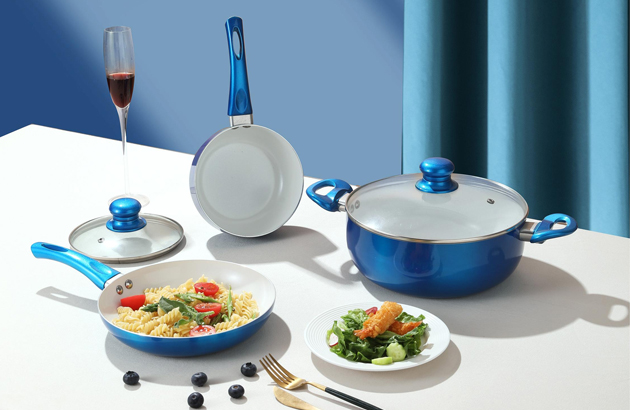
Pans with flat bottoms ensure full contact with electric or induction cooktops, minimizing cold spots. On gas stoves, slightly rounded edges can promote more uniform heat circulation. Designers optimize base geometry according to the intended use:
Sauté Pans: Wide, flat bases improve browning and evaporation.
Sauce Pans: Narrower bases with taller sides allow heat to circulate evenly around liquids.
Skillets: Gradual curves from base to rim facilitate even cooking when tossing or stirring ingredients.
Such design considerations may seem subtle, but they directly influence cooking consistency, especially for recipes requiring precision.
3. Edge and Rim Design
Rim shape is another factor affecting heat behavior:
Rolled Rims: Help prevent warping under heat stress and support lid stability.
Beveled Edges: Facilitate pouring without splashing, reducing heat loss from unnecessary stirring or spills.
Reinforced Rims: Provide additional strength, allowing the pan to maintain shape even under high-heat conditions.
These features, often overlooked by home cooks, are carefully implemented in professional-grade cookware from Zhejiang Wantong Industry & Trade Co., Ltd.
4. Multi-Ply Layering Technology
One of the more important innovations in heat distribution is multi-ply layering:
Three-Ply: Stainless steel + aluminum + stainless steel; ideal for home and semi-professional kitchens.
Five-Ply or Seven-Ply: Alternating layers of stainless steel and aluminum/copper; designed for professional kitchens requiring rapid heating and precise temperature control.
The combination of metals optimizes conductivity and retention. Chefs notice less scorching, uniform browning, and more control over delicate recipes.
5. Lids and Heat Retention
Cookware design isn’t limited to the pot or pan body; lids play a critical role in heat management. Well-fitting lids trap steam and distribute heat back into the food. Weighted or domed lids can further promote even cooking in braises, stews, and slow-cooked dishes. Using a properly designed lid enhances the thermal efficiency of Cooking Pots And Pans and reduces cooking time, conserving energy.
6. Ergonomic Considerations
Handles, pouring spouts, and balance points also influence cooking outcomes indirectly. Stable pans that are easy to maneuver reduce spills, allow consistent stirring, and maintain uniform heat contact. Professional Kitchen Cookware Suppliers like Zhejiang Wantong Industry & Trade Co., Ltd. incorporate ergonomic handles and carefully calculated balance points into their product designs.
Share:
Related Products

Need Custom Cookware? OEM & ODM Experts – Contact Us Today!
-

0086-578-3183238
-

0086-13750930689
-

-

86-13750930689
https://www.pinterest.com/zhuohao2021/ -

No.3 Xinye Road, Jinyun Industrial Area, Zhejiang, China.
Copyright © Zhejiang Wantong Industry & Trade Co., Ltd.

OEM/ODM Kitchen Cookware Manufacturer