 0
 language
 English
 русский
 Français
 Español
 Português
 عربى

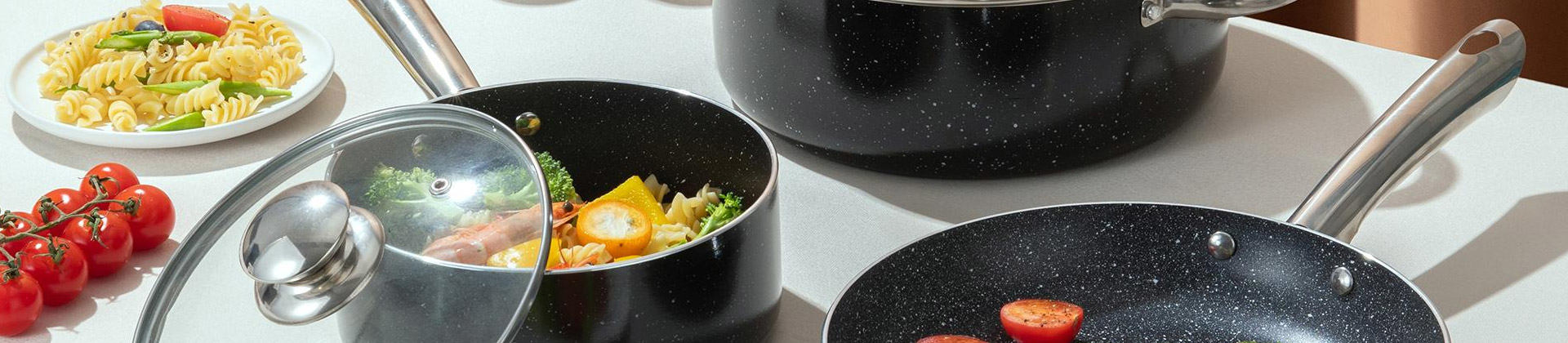
Aluminum Frying Pan Design: Addressing Coating Durability, Food Safety and Everyday Cooking Needs
Nov 06, 2026
As consumer expectations for cookware continue to change, an Aluminum Frying Pan is being evaluated on more than its appearance and price. Overseas retailers, kitchenware distributors, and private-label buyers are paying closer attention to nonstick coating safety, surface durability, heat distribution, and compatibility with different cooking habits. Discussions around PFAS in cookware have also made coating materials a more visible purchasing concern. For manufacturers, these changes highlight the need to address practical product performance rather than rely on appearance or marketing claims alone.

Growing Attention to Nonstick Coating Materials
Nonstick performance remains an important reason consumers choose aluminum frying pans. However, growing discussions about PFAS and chemical safety have encouraged buyers to examine coating composition more carefully. Terms such as PFOA-free, PFAS-free, PTFE-free, and ceramic nonstick are appearing more frequently in cookware searches.
These descriptions are not interchangeable. For example, PFOA-free does not automatically mean PFAS-free. As a manufacturer, we believe product descriptions should clearly identify the coating system and provide supporting test documentation where applicable. This gives distributors more reliable information when responding to customer questions and preparing products for different markets.
Preventing Premature Coating Wear During Daily Use
Coating durability directly affects customer satisfaction and product replacement decisions. Scratches, peeling, and uneven nonstick performance can result from unsuitable utensils, excessive heat, or inadequate surface preparation during production.
To address these concerns, manufacturers need to pay attention to several details:
- Surface preparation: A properly prepared aluminum surface supports coating adhesion.
- Coating application: Consistent application helps reduce uneven coverage and weak areas.
- Curing conditions: Controlled curing contributes to the intended coating properties.
- Finished-product inspection: Surface appearance and coating consistency should be checked before packing.
These production details help reduce avoidable quality problems and support more consistent bulk orders.
Improving Heat Distribution Through Pan Construction
Aluminum is widely used in cookware because of its relatively high thermal conductivity and manageable weight. However, cooking performance also depends on pan thickness, body construction, and base design.
A pan that heats unevenly may leave some ingredients undercooked while other areas become overbrowned. Excessive temperature changes can also affect cooking results. For this reason, buyers should consider the relationship between aluminum thickness, pan diameter, base structure, and intended cooking applications.
As manufacturers, we pay attention to these construction details when evaluating product designs for household cooking, restaurant supply, and retail cookware collections.
Induction Compatibility Requires Additional Design Consideration
The growing use of induction cooktops has created another important product-selection requirement. Traditional aluminum does not directly work with standard induction heating systems because it is not ferromagnetic.
For buyers targeting induction-compatible cookware collections, the base structure deserves particular attention. An aluminum frying pan may require a bonded magnetic stainless steel base to function on compatible induction cooktops.
When evaluating a supplier, buyers should confirm the supported heating methods rather than assume that every aluminum pan is suitable for induction cooking. Base flatness, bonding quality, and compatibility testing are also worth discussing before bulk production.
Handle Design and Cleaning Convenience Matter
A frying pan needs to remain comfortable and practical throughout everyday use. Handle attachment, grip shape, weight balance, and heat resistance can all influence the cooking experience.
Cleaning is another consideration frequently raised in consumer cookware reviews. Smooth interior surfaces and well-finished edges can make routine washing easier, while complicated joints may collect food residue.
For private-label buyers, handle materials, colors, surface finishes, and packaging presentation can also be considered during product customization, provided the proposed design meets the intended use requirements.
Quality Inspection Before Bulk Shipment
A product sample may look satisfactory, but consistent mass production requires more systematic quality control. Differences in coating appearance, body deformation, handle attachment, and packaging protection can create problems after products reach overseas distributors.
We recommend checking the following before confirming an order:
- Pan body dimensions and thickness consistency.
- Coating coverage and surface defects.
- Handle installation and attachment strength.
- Base flatness and heating compatibility.
- Packaging protection against scratches and transportation damage.
Clear inspection requirements help buyers and manufacturers establish consistent expectations before shipment.
Developing Aluminum Frying Pans Around Market Requirements
The cookware market is placing greater emphasis on transparent material information, dependable nonstick performance, practical construction, and compatibility with modern kitchens. For distributors and private-label brands, selecting an Aluminum Frying Pan should therefore involve more than comparing product appearance and unit prices. Working with a manufacturer that understands coating requirements, structural design, production inspection, and market-specific documentation can help reduce sourcing risks while building a cookware range that responds to real customer needs.
Share:
Related Products

Need Custom Cookware? OEM & ODM Experts – Contact Us Today!
-

0086-578-3183238
-

0086-13750930689
-

-

86-13750930689
https://www.pinterest.com/zhuohao2021/ -

No.3 Xinye Road, Jinyun Industrial Area, Zhejiang, China.
Copyright © Zhejiang Wantong Industry & Trade Co., Ltd.

OEM/ODM Kitchen Cookware Manufacturer